Carpenter ants don't eat wood the way termites do, but they tunnel through it to build their nests — and Suffolk County's older, wood-frame housing stock gives them plenty of places to do it undetected.
Carpenter ants are noticeably larger than most household ants — often 1/4 to 1/2 inch — and usually black or dark reddish-black. They're most active at night, so seeing a few large ants after dark, especially near a kitchen or bathroom, is a common first sign.
They're easy to confuse with termites when winged reproductives swarm in spring. Carpenter ants have a pinched waist and bent antennae; termites have a straight waist and straight antennae — a small but reliable difference.
Unlike termites, carpenter ants don't eat the wood they tunnel through — but repeated colonies excavating the same moisture-softened framing, window sills, or deck posts over several seasons can weaken structural wood in a way that's expensive to repair once it's found.
Carpenter ants are especially drawn to wood that's already damp or slightly decayed, which is why a leak or moisture problem often shows up as a carpenter ant problem first.
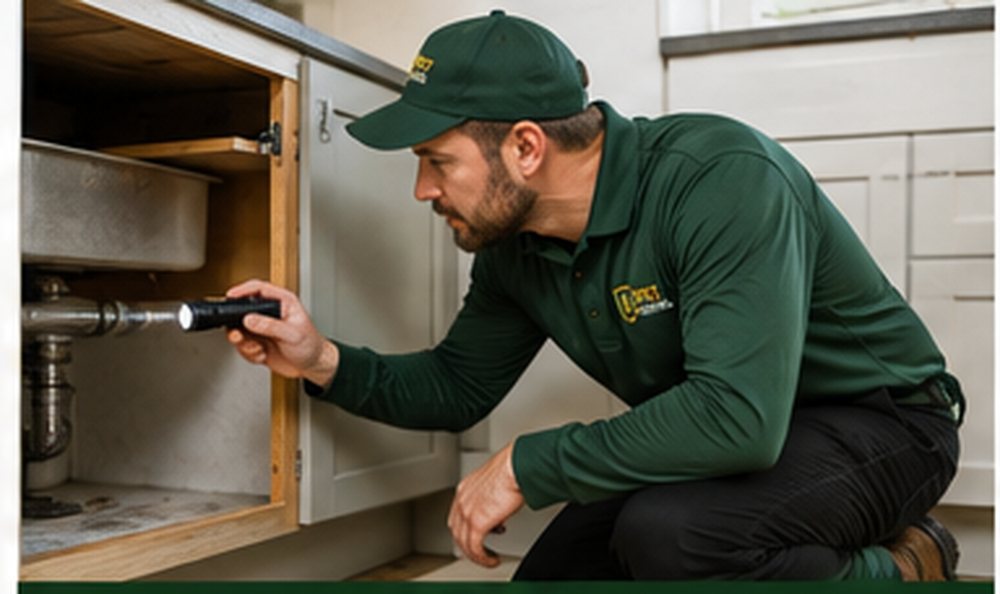
Finding the parent colony matters more with carpenter ants than with most pests — a satellite nest indoors is often being fed by a larger parent colony outside, sometimes in a dead tree or stump nearby. We inspect for entry points, frass, and moisture damage to trace activity back toward the source.
Treatment combines targeted product at nesting sites and entry points with addressing the moisture issue that likely drew them in — sealing without fixing the underlying dampness usually just delays the next colony.
This pest is covered under our Home Protection Plan.
Free inspection, no pressure — a real person calls back, usually same day.
Different kind of damage, but not something to ignore — carpenter ants don't eat wood for food the way termites do, but their tunneling can weaken structural wood over repeated seasons, especially where moisture has already softened it.
Carpenter ants have a pinched waist, bent (elbowed) antennae, and two pairs of unequal-length wings when swarming. Termites have a straight waist, straight antennae, and roughly equal-length wings. If you're not sure, a photo is often enough for us to tell over the phone.
Sometimes, sometimes not — it depends on how much structural wood is affected. We'll tell you honestly what we find during the inspection rather than assuming the worst.